A customer asked me last month why his team was pouring money into "ranking number one on ChatGPT." He'd seen a pitch for AI visibility services and assumed it worked like the SEO he'd bought for fifteen years: climb the list, win the click, count the traffic. I had to tell him the uncomfortable part. There is no number one. ChatGPT doesn't hand back a ranked page of ten blue links and let the shopper choose. It reads, retrieves, and writes one answer — and your product is either inside that answer or it isn't.
That distinction sounds academic until you watch revenue move. The shift from ranked lists to synthesized answers quietly rewrites what "being found" even means. And for anyone building a guided buying experience, it exposes a second truth the AI-visibility vendors rarely mention: getting mentioned in an answer and getting the right product into a customer's cart are two different jobs, and only one of them pays the bills.
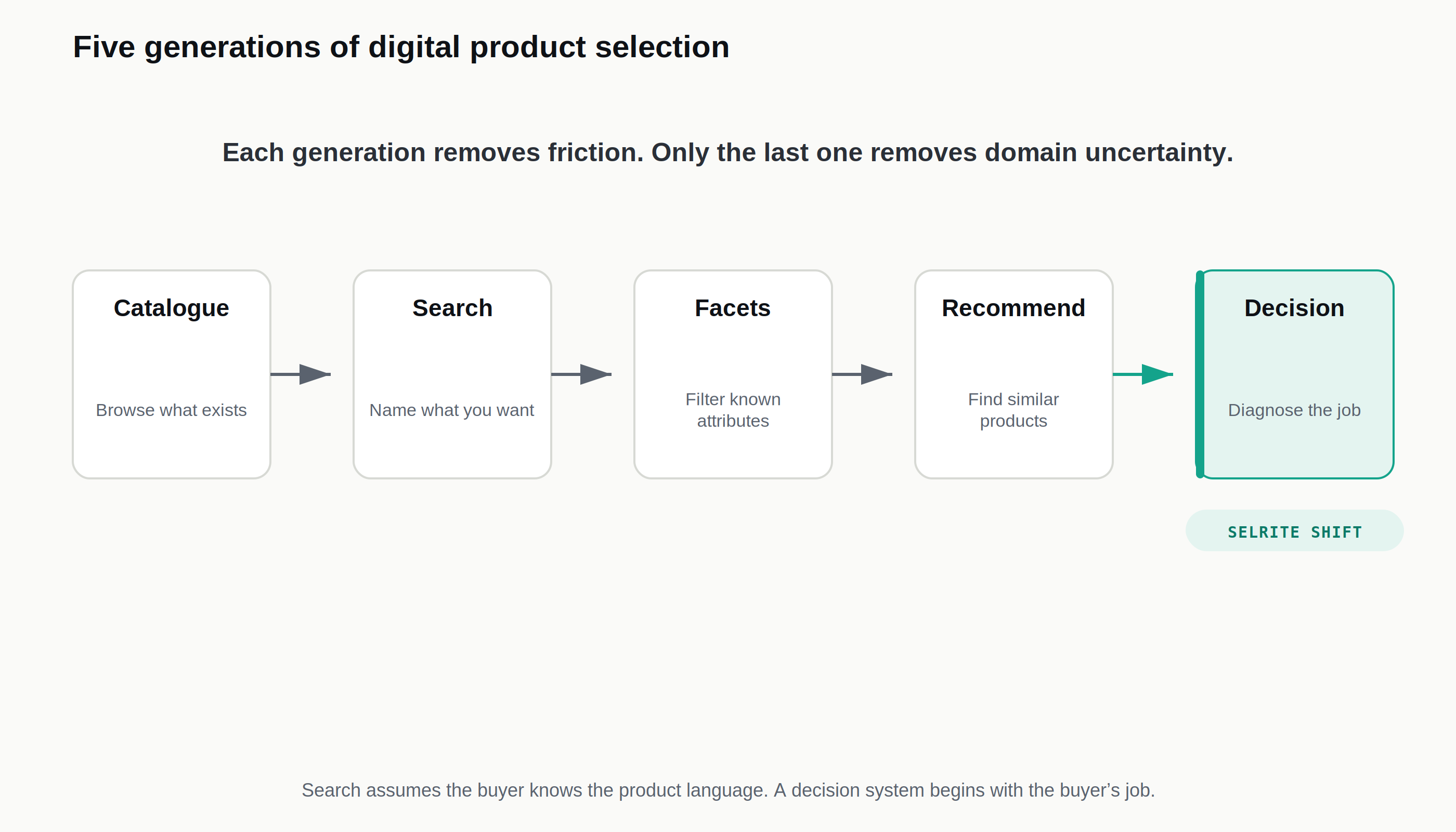
Search ranked pages. AI recommends answers.
Classic search is a ranking problem. Engines crawl your pages, weigh relevance and authority, and order the results so a human can pick. Two decades of e-commerce tactics grew out of that: clean category pages, crawlable architecture, keyword coverage, healthy feeds, reviews, structured data. None of that is dead. If anything, AI raises the stakes, because a model has to parse your content before it can summarize or recommend it. Garbage in still produces garbage out — it just produces it more confidently.
What changed is the surface. Google's AI features lean on a "query fan-out" — the system quietly runs a fistful of related searches across sub-questions, then assembles one response with a few supporting links. OpenAI's shopping behaves similarly: it asks clarifying questions, pulls current product and merchant data, compares options against your constraints, and tailors the shortlist. The output isn't a page you scroll. It's a recommendation you either trust or don't.
So the unit of competition moved. You're no longer only fighting for a position on a results page. You're fighting to be retrievable, understandable, and recommendation-worthy inside an answer you don't control.
Why "months behind" doesn't mean useless
The most common objection I hear is reasonable: large language models are trained on stale data, so how can they possibly help anyone shop for something that changes by the hour? Prices move. Stock runs out. Variants get discontinued.
The answer is that good shopping experiences were never running on model memory in the first place. They run on retrieval. The model supplies the reasoning; fresh data supplies the facts. When ChatGPT or an AI Overview gives a genuinely useful product answer, it's almost always reading current sources — merchant feeds, product pages, structured attributes — and then interpreting them for the shopper. Pretraining gives it language and judgment. Retrieval gives it the truth about your catalog today.
Hold onto that idea, because it's the whole game. The model is not the source of truth. The data you expose is.
What the "AI visibility" vendors are actually selling
A whole category has appeared almost overnight — GEO, AEO, LLMO, "AI visibility." The labels differ; the pitch is the same: make your products more likely to show up in AI answers. It's worth cutting through the acronyms, because underneath them the deliverables are mostly familiar work wearing a new badge.
| The promise | What it actually means | Why an AI system cares |
|---|---|---|
| "Get cited by ChatGPT" | Answer-first content, clean structure, accessible to crawlers | It can retrieve and quote you reliably |
| "Boost AI visibility" | Tracking mentions and citation share across AI tools | You can measure presence when clicks aren't the outcome |
| "Optimize for GEO/AEO" | Schema, entity consistency, FAQs, freshness | Better structure maps your pages to real intent |
| "Win AI shopping" | Stronger feeds, product attributes, comparison and trust signals | Shopping answers need current facts and decision criteria |
None of this changes the model. It changes the inputs the model leans on. That's not a knock — it's genuinely useful work. But notice what it optimizes for: being *found and quoted*. That is a discoverability win. It is not the same as a buying decision, and conflating the two is where a lot of budgets go to die.
Three systems, not one channel
The cleanest way to stop the confusion is to stop calling all of this "AI." There are really three overlapping systems, and they reward different things.
| System | The job | What wins | The metric that matters |
|---|---|---|---|
| Classic search | Rank pages for a query | Relevance, authority, crawlable feeds | Rankings, clicks, traffic |
| AI search overlays | Synthesize an answer from many sources | Retrievable passages, structure, citation-worthiness | Mentions, citations, assisted visits |
| Guided product discovery | Narrow options and justify a shortlist | Current attributes, constraints, trade-offs, fulfillment reality | Conversion quality, shortlist fit, assisted revenue |
Ranking gets you into the candidate set. Guided reasoning decides whether *this* product is right for *this* buyer, right now, under real constraints. Most teams are using SEO vocabulary to describe what is, underneath, a recommendation problem. The grammar is wrong, so the spending is wrong.
What actually gets a product picked
A search engine will happily rank a thin page if the other signals are strong. A recommendation workflow won't. To put your product in an answer and defend it, the model needs enough context to explain *why it fits*.
The pages that win recommendations tend to make selection easy:
- Explicit use cases — "best for small rooms," "rated for forklift traffic," "good for exterior concrete"
- Real attribute depth — specs, compatibility, dimensions, policies, delivery constraints
- Comparison-ready language that names trade-offs instead of only making claims
- Reviews and FAQs that map to how people actually decide
- Pricing, stock, and variant availability that are current, not aspirational
The takeaway is layered, not either/or. SEO gets you into the retrieval set. Structured data helps the system parse your catalog. And rich product intelligence is what lets the model justify choosing you over the alternative sitting right next to you in the answer.
Why guided buying runs on RAG
For anything beyond a trivial purchase, a generic AI answer isn't enough — because buying depends on live state. Price. Stock. Shipping promise. Seller rules. Compatibility. Promotions. Returns. Geography. Sometimes a constraint specific to this one customer.
That's exactly the problem retrieval-augmented generation was built for. Instead of asking a model to answer from frozen training data, a guided system retrieves the relevant catalog, policy, and preference data first, then asks the model to reason over that grounded context. The fluency comes from the model. The facts come from your systems.
A serious guided-buying stack usually has four layers:
- Catalog intelligence — normalized attributes, variants, bundles, taxonomy, compatibility
- Live commerce state — pricing, availability, shipping windows, promotions, location rules
- Decision retrieval — semantic and structured search across use cases, reviews, FAQs, policies
- Deterministic reasoning and inference — the layer that applies your engineering and business rules to narrow the set, exclude what doesn't fit, and explain the trade-offs in plain language
Notice that retrieval and reasoning are two different layers, not one. Retrieval brings the evidence; inference makes the decision. Blur them together and you get the classic failure — a system that retrieves five technically correct documents and still recommends the wrong product. RAG grounds the answer; it doesn't, on its own, decide it. Call it RAG++ if you like: retrieval to ground the recommendation, then a deterministic reasoning layer on top to actually make the call.
This is the right shape for high-consideration and configurable purchases — the ones where a customer doesn't want "top products," they want "the best fit given my budget, my constraints, and what I'm actually trying to do." It's also the only version a merchant can keep controllable, auditable, and aligned with real business rules.
Your catalog knows things ChatGPT never will
This is the part external AI tools structurally cannot match. A public model knows the market broadly. You know the operational truth: which variant is in stock, what can ship by Friday, which bundle protects margin, which accessory is actually compatible, which exception has to be disclosed before checkout.
| Capability | Generic AI answer | Site-level guided RAG |
|---|---|---|
| Uses current catalog state | Sometimes, if it retrieves it | Yes — wired to your systems |
| Sees your policies and exceptions | Rarely | Yes |
| Asks clarifying questions | Yes | Yes |
| Enforces business rules | No | Yes |
| Personalizes on first-party context | Limited | Yes |
| Optimizes conversion and fulfillment together | No | Yes |
Expose your first-party data to a buying agent and the math flips in your favor. The goal isn't only to answer a shopper's question elegantly. It's to produce a recommendation you can actually fulfill — and stand behind.
What to do about it
You don't have to choose between "AI visibility" and "guided selling." You need both, in order, and you need to measure them differently.
- Fix the retrieval layer. Make important product and comparison pages crawlable, don't accidentally block the right bots, and add schema where it genuinely clarifies products, FAQs, and breadcrumbs.
- Make content answer-ready. Lead with use cases, trade-offs, and selection criteria. Write comparisons around real buyer intent, not marketing categories. Keep passages clean enough to be quoted.
- Add live decision grounding. Connect pricing, inventory, shipping, and compatibility to the recommendation layer, and log *why* each item was recommended so the system stays auditable.
- Measure the right things. Track mentions and citation share for visibility — but track shortlist relevance, assisted conversion quality, and AOV impact for the part that actually sells.
Don't confuse a content win with a commerce win. They live in different columns of the spreadsheet.
Where Selrite fits
This is the line between a guided selling system and a chatbot bolted onto a product page. A chatbot answers questions. A guided system shapes the decision — it reads the shopper's intent, narrows the catalog intelligently, and recommends something that can actually be fulfilled under today's conditions.
That's the failure mode worth designing against: fluent, confident, ungrounded recommendations. The more expensive or configurable the purchase, the more that failure costs you. For high-stakes commerce, retrieval isn't a nice-to-have bolted on at the end — grounding is what makes a recommendation possible and current. But grounding is where trustworthy selling starts, not where it ends: the deterministic reasoning layer on top is what makes the recommendation correct and defensible.
Selrite is built for exactly that. Not "get the LLM to mention your product," but a guided system that understands the shopper, retrieves the right evidence from your own catalog and rules, and produces a recommendation that's both persuasive and operationally correct.
LLM product discovery is related to search ranking, but it isn't the same sport. The pipeline now is retrieval, extraction, synthesis, and guided recommendation — not position on a list. Brands still need optimization so AI systems can find and understand their products. But merchants need grounded, guided selling so those recommendations stay current, explainable, and commercially real. Don't bet your cart on model memory. Ground it in your own data, and let the reasoning happen on top.
That reasoning layer — where deterministic rules decide, not just retrieve — turns out to be the whole ballgame, and it's a bigger topic than a single section can hold. I picked it apart in Why Most AI Product Advisors Fail: why RAG is necessary but not sufficient, and the layered architecture that gets a technical recommendation right.