Beyond the Search Bar
How guided decision architecture unlocks digital commerce for complex and technical products — a 22-page field guide for the people building AI into commerce, manufacturing and technical product selection.
Enterprise AI is moving from fluent answers to accountable outcomes. This guide sets out the layered architecture that gets it there: language models, ontologies, retrieval, deterministic inference and commerce systems, each doing only what it is uniquely qualified to do.
Get the guide
Download opens straight away. We'll email you a copy so it doesn't get lost in a tab.
Understanding is probabilistic. Decisions are deterministic. Transactions are transactional.
Understand
Use language models to interpret intent, entities, context and candidate meanings.
Structure
Use an ontology to connect the customer's problem to the systems and concepts that matter.
Decide
Use evidence, governed rules and deterministic calculations to produce an explainable recommendation.
The customer describes symptoms. Your catalogue describes products.
For almost thirty years digital commerce has optimized discovery. Search got faster, filtering got richer, recommendations got smarter. Industrial sites still fail — because customers are not trying to discover products. They are trying to solve problems.
EPX-2047 Heavy Duty Primer
A part number, a spec sheet and a filter tree. All of it assumes the buyer already knows the answer they came to find.
"My warehouse floor is dusting."
Or: "Water enters the basement after heavy rain." The buyer has a job, a substrate and a deadline — not a SKU.
Bridging that gap is not a search problem. It is a decision problem.
What's actually inside
Twelve diagrams work through the architecture end to end. Here are three of them.
Search was never the last generation
Catalogue, search, facets and recommendations each removed a layer of friction. None of them removed domain uncertainty — the part where the buyer has to already be the expert.
Five stages of digital product selection
Search assumes the buyer knows the product language. A decision system begins with the buyer's job.
Authority does not follow data volume
The systems holding the most data are not the systems that should be exercising the most judgement. Separating the two is what makes a recommendation safe to act on.
The decision pyramid
Lower layers own more state. Higher layers exercise more judgement. Authority does not follow data volume.
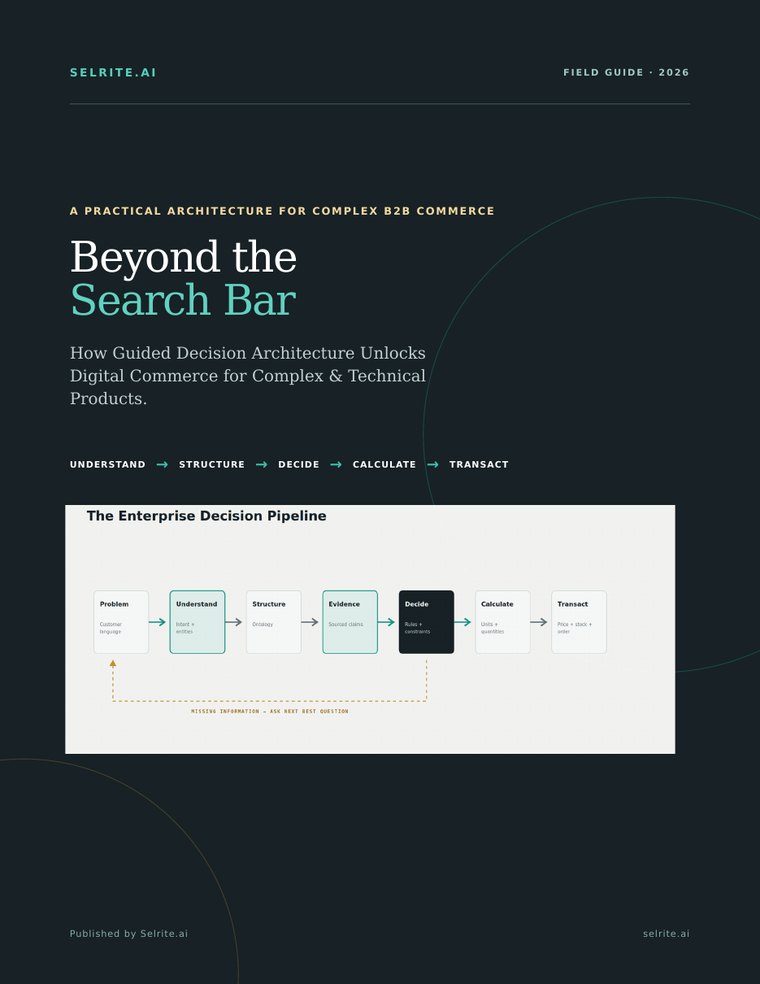
A decision flow, not a data flow
The difference is the amber path. A pipeline that can detect what it does not yet know — and ask the one question that changes the outcome — is doing diagnosis, not interrogation.
The enterprise decision pipeline
This is a decision flow, not merely a data flow. It can pause, ask, review and resume.
Fifteen chapters
The guide follows the decision from the customer's words to a governed, commercially safe transaction.
- Introduction
- Why Traditional Commerce Breaks Down
- The Four Generations of Product Selection
- Separate Responsibilities
- The Role of the Ontology
- Retrieval Is Evidence, Not Truth
- The Inference Engine
- Why Explainability Matters
- Guided Selling as Diagnostic Reasoning
- Coverage, Pricing and Commerce
- AI as an Orchestrator
- Reference Architecture
- Implementation Roadmap
- Common Anti-Patterns
- Conclusion
Six anti-patterns the guide names
If more than two of these describe your current stack, the guide is written for you.
- Treating an LLM as a rules engine.
- Letting RAG determine commercial truth.
- Embedding business rules inside prompts.
- Mixing pricing logic with recommendation logic.
- Allowing free-form AI to calculate regulated engineering values.
- Optimizing search instead of reducing uncertainty.
Written for people who have to be right
Coatings, adhesives, sealants, industrial
You publish technical products whose buyers describe conditions, not part numbers — and where wrong means a failed bond, a ruined floor or a voided warranty.
Digital & e-commerce directors
Your search is tuned and your facets are clean. Conversion still stalls at exactly the point where the buyer is expected to be the expert.
Teams past the RAG demo
You shipped an assistant that answers fluently. Now you need decisions that are explainable, governed, auditable and safe to transact against.
The future belongs to the clearest architecture, not the largest context window.
Twenty-two pages, twelve diagrams, one reference architecture and an implementation roadmap in five phases. Free, no sales call attached.
This publication presents an architectural viewpoint. Product names, thresholds, quantities and commercial details in the examples are illustrative and are not engineering, safety or purchasing advice.
Download the field guide
Opens immediately. A copy lands in your inbox too.
Or skip ahead and watch it run.
Selrite applies this architecture to complex B2B product selection — turning fragmented manufacturer knowledge into governed decision support for buyers who know the problem, not the SKU.